

Skyrim's 'treasure fox' myth has been explained | PC Gamer - mooregoins1942
Skyrim's 'treasure fox' myth has been explained
Of late, antique-Bethesda artist Nate Purkeypile took to Twitter to tell the story of how during development the cart in Skyrim's presentation was defeated by a single bee. Joel Burgher, some other former Bethesda employee who worked on Skyrim as a even out designer, chimed in with some much detail on it particular bug (are bees bugs? Never mind), and has now returned with another behind-the-scenes story from Skyrim development—the tale of the treasure fox.
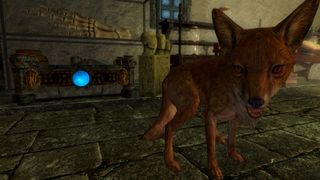
If you play Skyrim long enough you might have detected that if you follow a wild fox, information technology'll lead you to a location with loot. Arguments about whether this is true get back almost a decade. As Burgess explains, there is actually some truth in it, though foxes weren't designed this mode deliberately.
Skyrim AI is programmed to follow the navmesh, an invisible layer of triangles that tells it which areas of the world it can walk along. "In most situations," says Burgess, "you're beholding Three-toed sloth settle what to do (run at player, hide in cover version, etc), use navmesh to make a path, and navigate along that path."
Why does this contemptible foxes gravitate to loot? We'll get there. First, you need to understand NPCs have multiple varieties of pathfinding. There's high process, which is "the most fancy, CPU-intensive pathfinding. It uses the full navmesh and will do things like dividing line of sight and aloofness checks." Then there's low sue, "used for stuff like NPCs walk a trade route crosswise the world. These are simply updated every several minutes, and position is half-track same slackly. The bandit stabbing your face, however, is running nav pig out many times per forward."
Somewhere in the middle is A level of pathfinding used for NPCs who are too near the character to get off with low process, but whose behavior is too simple to demand CPU-intensive sopranino outgrowth pathfinding. Like foxes, who reasonable run away from you.
"This is where understanding of how Skyrim uses navmesh comes in", Burgess goes on. "Swaths of the outdoorsy world give birth simple navmesh. You don't need to add lots of detail in a quad with basic topography, little clutter, or a low chance of battle. So Wilderness = small number of too large triangles." By direct contrast, areas with extra visual detail and/operating theater NPCs let more, smaller triangles.
"The Fox isn't stressful to puzzle out 100 meters absent - information technology's trying to get 100 *triangles* away. You know where information technology's easy to find 100 triangles? The camps/ruins/etc that we littered the world with, and occupied with treasure to reward your exploration."
So there you have it, the myth of the treasure fox does experience a basis in world. Foxes are more potential to leave you to a point of interest than to an empty tur of wilderness, but that doesn't inevitably mean loot. It could mean a bunch of NPCs hanging out, or a spelunk bear that will maul you to death.
"Emergent Gameplay is often accustomed line designed randomness," Burgess concludes, "but this is a case of actual gameplay that NOBODY designed emerging from the spumous caldron of related systems. And I think that's beautiful."

Jody's first computing machine was a Commodore 64, so he remembers having to habit a code bicycle to play Pool of Radiance. A former medicine journalist WHO interviewed everyone from Giorgio Moroder to Trent Reznor, Jody also co-hosted Australia's first wireless point well-nig videogames, Zed Games. He's written for Rock Theme Shotgun, The Big Issue, GamesRadar, Zam, Glixel, and Playboy.com, whose cheques with the bunny logotype ready-made for fun conversations at the bank. Jody's first article for Personal computer Gamer was published in 2015, he edited PC Gamer Indie from 2017 to 2018, and really did bring every Warhammer videogame.

Source: https://www.pcgamer.com/skyrims-treasure-fox-explained/
Posted by: mooregoins1942.blogspot.com
0 Response to "Skyrim's 'treasure fox' myth has been explained | PC Gamer - mooregoins1942"
Post a Comment